
What if the design isn’t the hardest part of planning event shirts? The bigger challenge is deciding who needs one, what each shirt is for, and when the shirts need to be ready. With custom shirts for events, sorting out those details early helps you estimate quantities, collect sizes, and avoid a last-minute rush.
It’s easy to start with artwork, but choosing a design before you’ve settled the audience and timing can make the process harder. A little planning gives you a clearer path from the first idea to the finished shirts.
This checklist covers how to set a purpose, estimate quantities and size ranges, choose a shirt and design, and build a realistic timeline. Joe’s Unique Creations prints custom apparel in-house using DTF, a method suited to vibrant, full-color artwork on shop-provided garments.
Key Takeaways
- Choose the shirts’ main purpose first: identifying staff, building team spirit, marking participation, or supporting a fundraiser.
- For custom shirts for events, set a size-request deadline, total the confirmed requests, then decide whether extra shirts make sense.
- Choose apparel with the people wearing it and the event setting in mind.
- Work backward from event day, leaving time for size collection, artwork review, production, delivery, and sorting.
- Joe’s Unique Creations prints custom apparel in-house using DTF on shop-provided garments, including vibrant, full-color event artwork.
Custom Shirts for Events: Start With the People and Purpose
Planning shirts for a group means balancing what wearers need with what the event calls for and how the shirts will be ordered and handed out. Start with the people, not the artwork. A staff shirt, team shirt, and attendee keepsake may all carry the event name, but each serves a different purpose.
First, decide who will wear the shirts, when they’ll wear them, and how they’ll receive them. Volunteers working outdoors for several hours have different needs from guests picking up a shirt at registration. These details help guide your garment, design, and quantity decisions.
Write down the basics before moving forward:
- Audience: Who is included, and who is not?
- Use: Will shirts identify people, mark participation, serve as keepsakes, or support a fundraiser?
- Quantity and sizes: How will you collect requests and track the count?
- Artwork: What event name, logo, or message needs to be easy to recognize?
- Deadline and distribution: When must the shirts be ready, and who will hand them out?
Match the shirt plan to the kind of event
For staff, make recognition the priority. Use a clear design that’s easy to spot, especially if guests will need help finding someone. Team shirts should build a shared identity and make group coordination simple. For attendees, decide whether the shirt is a giveaway, a keepsake, or something participants receive for taking part in an activity. That choice affects who gets one and how you estimate the quantity.
Consider the setting, too. A shirt worn during active outdoor activities needs to suit the day’s plans. One given to guests at an indoor gathering may serve mainly as a memento. For background on one apparel decoration method, Wikipedia’s Screen Printing Process explains screen printing. This is general information, separate from deciding what your event shirts need to accomplish.
Decide what success looks like before choosing details
Choose one primary goal. If visibility matters most, keep the message easy to read. If team identity is the goal, make the shared name or mark prominent. If shirts are part of a fundraiser, define who can buy one and how orders will be handled. A clear priority keeps the artwork and ordering decisions focused instead of asking one shirt to do everything.
Set expectations early: who pays, who gets a shirt, and whether distribution happens at check-in, before the event, or through a group organizer. Note practical constraints as well, such as the setting and planned activities. These decisions create a useful starting point for custom shirts for events and make the next steps, from sizing to timing, easier to manage.
How to Plan Event Shirt Sizes and Quantities Without Guesswork
A reliable count starts with names, not a guess about how many people might show up. For custom shirts for events, separate confirmed participants from estimates, then track each person’s requested size. Registration lists, team rosters, and staff schedules provide a starting point. If attendance is uncertain, keep estimates separate so they aren’t mistaken for confirmed orders.
Use this sequence:
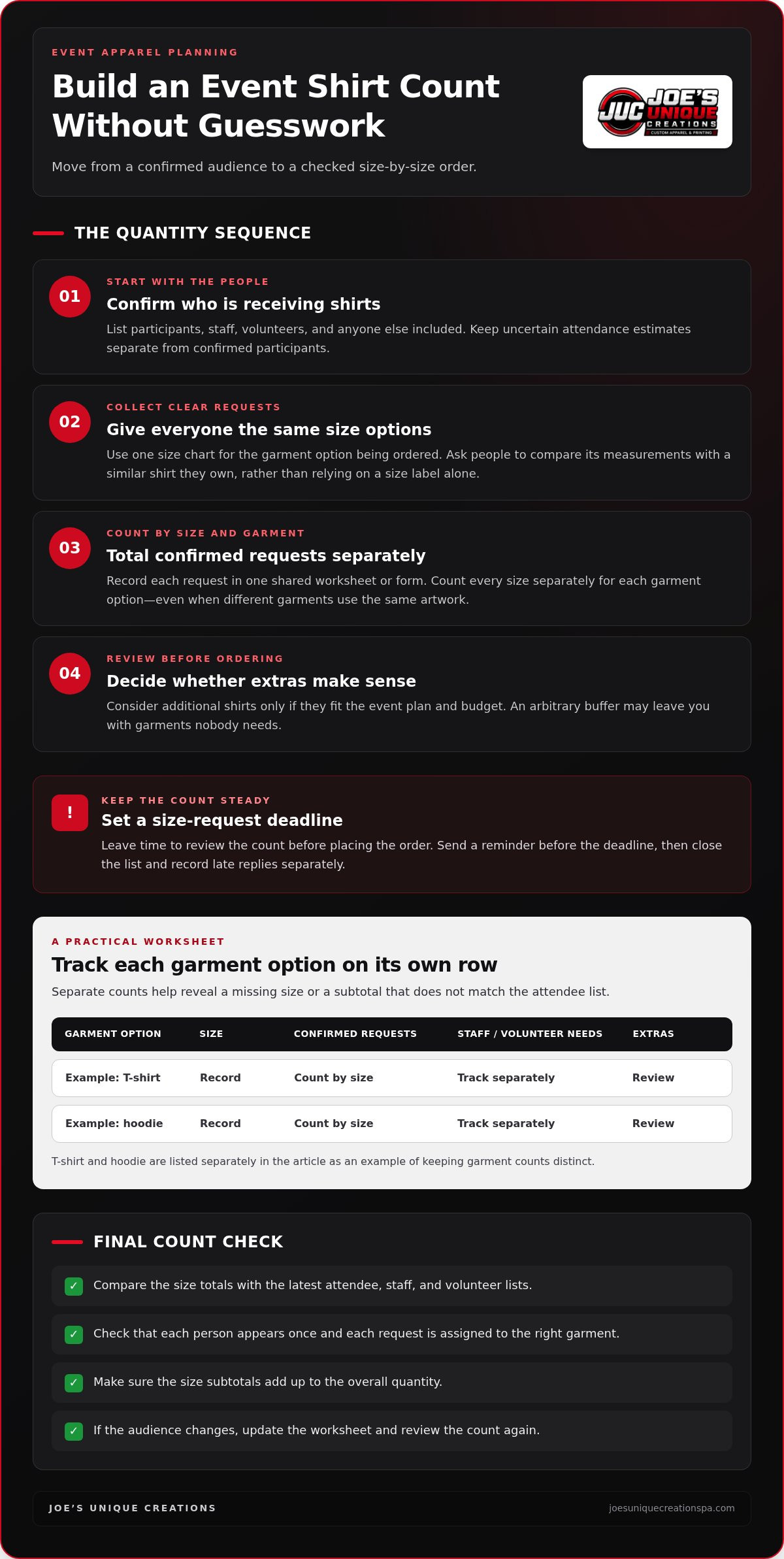
- Confirm the audience. List participants, staff, volunteers, and anyone else receiving shirts.
- Collect sizes. Give everyone the same options and a clear response deadline.
- Total requests. Count each size separately for every garment option.
- Review extras. Decide whether additional shirts suit your event and budget.
Set a firm size-request deadline that leaves time to review the count before placing the order. Send a reminder before the deadline, then close the list and record late replies separately. This prevents last-minute responses from changing the total without being noticed.
Collect sizes in a way people can answer easily
Use one consistent size chart for the garment option you’re ordering. Ask participants to compare the chart’s measurements with a similar shirt they own instead of relying on a size label alone. Keep the choices clear and record each request in one shared worksheet or form. Don’t assume one fit or size range will work for everyone. Use the options available for the selected garment.
A simple worksheet can include a separate row for each garment option, with columns for size, confirmed requests, staff or volunteer needs, and extras. For example, list a T-shirt and a hoodie on separate rows, even if they use the same artwork. Separate counts make it easier to spot a missing size or a subtotal that doesn’t match the attendee list.
Build a quantity plan around confirmed participation
Start with confirmed participants, then count staff and volunteers separately. Keep uncertain attendance estimates in a separate note, not in the confirmed total. Consider extra shirts only if the budget and event plan allow them. Extras can cover a late addition, but an arbitrary buffer may leave you with garments nobody needs.
Before approving the order, compare the size totals with the latest attendee, staff, and volunteer lists. Check that each person appears once, each request is assigned to the right garment, and the size subtotals add up to the overall quantity. If the audience changes, update the worksheet and review the count again.
Once your list is settled, Joe’s Unique Creations can turn it into an order for custom printed event apparel, printed on shop-provided garments.
Choose Custom Event Shirts That Fit the Design and the Day
A design that looks good on screen still needs to work for the people wearing it. Consider the activities, audience, and setting before choosing a garment. A shirt for staff who need to be recognized serves a different purpose from one guests might keep as a memento. Use each group’s role to narrow your choices before settling on artwork.
Compare apparel choices by event role
Think about what each group needs from its shirt. Staff benefit from clear identification, while active participants need apparel suited to their planned activities. For giveaways and keepsakes, consider whether the garment and design will still appeal after the event. This comparison can help focus the decision:
Staff
Prioritize easy recognition. Keep the logo or event name readable from a distance.
Decision: Can guests quickly tell who can help?
Participants
Consider movement, activity, and the event setting when choosing a shirt style.
Decision: Will it suit what people will be doing?
Giveaway or keepsake
Choose a design people may want to wear beyond the event.
Decision: Does it feel like a useful memento or participation item?
For example, consider the day’s plans when choosing a shirt for an outdoor activity. A shirt handed out at an indoor gathering may be valued mainly as a reminder of the event. Match the garment and design to the actual use, rather than choosing by appearance alone.
Keep event artwork clear and ready to approve
Make the design easy to understand at a glance. Start with the event name, one key visual, and only the supporting details people need. Check that essential text remains legible at the planned print size. Review the artwork alongside the shirt color and print placement, since each affects how the finished design reads.
Joe’s Unique Creations prints custom apparel in-house using DTF, or direct-to-film printing. The design is printed onto transfer film and applied to the garment. DTF is a practical option for vibrant, full-color event artwork on shop-provided garments. Review the design and garment together, not as separate choices.
Keep the final review focused. Confirm the event name is correct, the main visual is clear, and the shirt color supports the design. Then check that the garment fits the event role and planned activities. This helps custom shirts for events feel intentional and useful, whether they identify a team or give attendees something to remember the day by.
Build an Event Shirt Timeline and Use This Final Checklist
Work backward from the event date and give each decision a place on the calendar. Size collection, artwork approval, ordering, production, delivery, and sorting all take time and attention. If one step slips, the next can get squeezed. A written timeline shows everyone what needs to happen and who is responsible for moving it forward.
Set milestones before the event gets busy
Choose a deadline for size requests and a separate date for approving the final artwork. Leave time after approval to place the order, allow for production and delivery, and sort the shirts before event day. Base those dates on the order plan and delivery estimates. Avoid relying on a general turnaround assumption; the schedule should fit your specific order.
Assign one person to track the timeline and communicate changes to the group. That person can follow up on sizes, artwork approval, and delivery arrangements. Joe’s Unique Creations offers same-day printing for qualifying orders using in-stock garments. Same-day printing isn’t guaranteed, so build the plan around the timing for your order rather than counting on it as a fallback.
A backward plan might look like this:
- Event day: Shirts are ready at the planned handout point.
- Before event day: Set aside time to sort and count the delivered shirts.
- Order stage: Allow for production and delivery based on the order’s estimates.
- Before ordering: Close size requests, check totals, and approve the artwork.
- At the start: Name the person tracking updates and set the size-request deadline.
Prepare a simple event-day distribution plan
Decide how shirts will reach people before the event begins. If practical, sort them by size or participant name and label each group clearly. Choose a pickup spot that fits the schedule, such as a check-in table or a designated organizer. Keep a final count of what arrived and what was handed out. That record helps identify missing or unclaimed shirts without relying on memory.
Before finalizing the order, use this last review for custom shirts for events:
- Do the quantity and size totals match the latest participant and staff lists?
- Has one person approved the artwork, including the text, garment color, and placement?
- Does the plan account for production and delivery estimates?
- Is someone responsible for receiving, sorting, and distributing the shirts?
Once your checklist is in order, plan your event shirt order with Joe’s Unique Creations. Apparel is printed in-house using DTF on shop-provided garments.
Order Custom Shirts for Your Event With Joe's Unique Creations
Once your event plan, size list, and artwork are coming together, choose how to bring the shirts to life. Joe’s Unique Creations makes custom event T-shirts and apparel, printed in-house using DTF. This method transfers your design onto the garment and works well for vibrant, full-color artwork, including event graphics with multiple colors or detailed elements.
Apparel is printed on shop-provided garments, giving you a clear starting point for choosing a shirt and reviewing the design together. Joe’s Unique Creations works with individuals, groups, teams, and corporate clients on custom apparel.
What to have ready for an event shirt order
You don’t need every detail settled before starting a conversation. A few useful notes can keep planning focused and help shape an order around your event.
- Event date and purpose: Note when the shirts are needed and how people will use them.
- Approximate quantity and sizes: Bring your current count and collected size requests, even if some details are still being finalized.
- Artwork and shirt color: Have the design ready to review, along with your preferred garment colors.
- Event-day needs: Share any sorting or distribution plans that could affect how you want the shirts organized.
If the final count is still changing, separate confirmed requests from estimates. That distinction keeps the plan clear as you move from early ideas toward an order. It’s also useful to identify the artwork details that matter most, such as the event name, a key graphic, or text that needs to stand out.
Get started with a straightforward conversation
Start by describing the event and the people who will wear the shirts. Share the intended use, approximate quantity, size requests, artwork, and preferred shirt colors. If you’re still deciding on something, include that in your notes. A clear conversation helps focus on what matters for the order without making the process feel complicated.
For qualifying orders, same-day printing is available when the needed garments are in stock. It isn’t guaranteed, so plan around your event date and the timing for your order rather than treating it as a sure fallback.
Ready to talk through your event plan? Start your custom event shirt order with Joe’s Unique Creations.
Make Your Event Shirt Plan the Start of Something Good
You don’t need a perfect design or a finished plan to get started. Begin with what you know: what the event means to your group and how you want people to feel when they wear the shirt. That starting point can help turn an early idea into apparel that feels connected to the occasion.
Joe’s Unique Creations works with individuals, groups, teams, and companies on custom apparel. In-house DTF printing brings full-color designs to custom shirts and other apparel. Same-day printing is available for qualifying orders using in-stock garments, but it isn’t guaranteed.
Bring your event idea, even if some details are still taking shape. Plan custom shirts for your event with Joe’s Unique Creations.
Frequently Asked Questions
How much do custom shirts for events cost?
The cost depends on the garment, order quantity, and artwork details, so there isn’t one price that fits every event. To get a useful quote, share your estimated count and note whether you’re considering different garment options or designs for separate groups. For example, staff and attendees may need different apparel. A clear breakdown helps shape an order around your event plan without paying for guesses or unnecessary extras.
Can I order custom event shirts without supplying the garments?
Yes. Joe’s Unique Creations prints custom T-shirts and apparel on shop-provided garments, so you don’t need to bring clothing for printing. As you plan, consider which garment options suit the people wearing them and the event. If you’re ordering more than one type, keep the quantities and size requests separate for each option. That makes the order easier to review before production.
Can I get custom event shirts printed the same day?
Same-day printing is available for qualifying orders that use in-stock garments, but it isn’t guaranteed. If your event is close, share the event date and garment needs early. Keep a backup plan for identifying staff or participants if the shirts aren’t ready in time. For future events, leave room in the schedule for artwork review, production, and delivery rather than relying on a rush option.
What file format should I use for custom shirt artwork?
Use the cleanest, highest-quality version of the artwork you have. Vector artwork, such as an SVG or print-ready PDF, can be useful because it can be resized while keeping edges crisp. A large PNG with a transparent background may also work well for many designs. Avoid sending a small screenshot or an image copied from a webpage, since it may look blurry when enlarged for printing.
How should I wash DTF-printed event shirts?
Follow the care instructions on the garment label first, since the shirt fabric also matters. As a cautious routine, turn the shirt inside out, wash it in cool water with regular detergent, and avoid bleach or harsh stain treatments on the printed area. Let it air-dry when practical, or use a lower dryer setting. Don’t iron directly over the design. Handle any printed shirt gently until you know how it responds to washing.
What should I do with leftover shirts after an event?
First, count and record what remains, including each size and garment type. If the design isn’t tied to a specific date, you could keep a small, labeled supply for late participants or future group needs. Shirts with event-specific details may be better suited to donation or another planned use. Store them clean and dry, and note who is responsible for the remaining stock so it doesn’t get forgotten.

